Pink Rb Font: Where Playful Typography Meets Strategic Design
Typography is no longer just about legibility—it’s a strategic asset. In an era where attention is fragmented, emotional resonance drives engagement, and brand authenticity is non-negotiable, Pink Rb Font arrives not as a novelty, but as a timely response to evolving creative and commercial needs. More than a color font, it’s a design language—one that merges chromatic expressiveness with typographic precision to deliver joy, clarity, and memorability in equal measure.
What Is Pink Rb Font—Beyond the Name
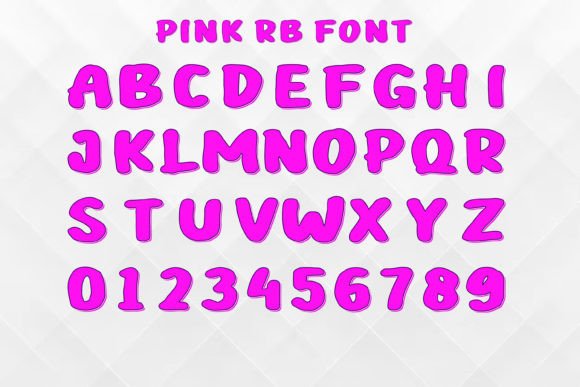
Pink Rb Font is a fully vector-based, OpenType-SVG color font designed for modern digital and print workflows. Unlike static PNG overlays or layered effects, it renders natively in supported applications—including Adobe Creative Cloud (Illustrator, Photoshop, InDesign), Figma, and modern web browsers—without compromising scalability, accessibility, or performance. Its “pink” designation reflects its signature chromatic identity: a vibrant, carefully calibrated rose-pink hue applied directly to glyph outlines, while “Rb” signals its structural foundation: a robust, rounded sans-serif skeleton optimized for readability at all sizes.
Crucially, Pink Rb Font is engineered with intention—not decoration. Each letterform balances friendly curves with clean geometry, ensuring visual warmth without sacrificing professionalism. It supports full Latin character sets, multilingual diacritics, ligatures, and stylistic alternates, making it viable for global branding—not just decorative accents. This duality—emotionally engaging yet technically rigorous—defines its utility across contexts far beyond whimsical social posts.
The Cultural Shift Behind Color Fonts’ Rise
Color fonts like Pink Rb Font are gaining traction because they align with three converging trends: the democratization of expressive design tools, the consumer demand for human-centered aesthetics, and the growing expectation for seamless cross-platform consistency.
Historically, adding color to type required manual layering, complex scripting, or platform-specific workarounds—slowing iteration and increasing file bloat. Today, native color font support eliminates those friction points. As Figma introduced robust SVG font rendering and Adobe rolled out broader OpenType-SVG compatibility, designers gained the ability to deploy rich typographic color *as text*—retaining editability, SEO-friendliness (in web contexts), and responsive behavior. This isn’t just convenience; it’s a workflow evolution that empowers faster prototyping, more accurate client presentations, and tighter brand control.
Simultaneously, audiences—especially Gen Z and younger millennials—are responding to design that feels intentional *and* emotionally intelligent. Clinical minimalism still holds value, but it increasingly shares space with warmth, tactility, and subtle playfulness. A 2023 Adobe Creative Trends Report noted a 68% year-over-year increase in usage of “chromatic typography” in brand refreshes—particularly in wellness, edtech, and sustainable commerce sectors. Pink Rb Font meets this need by offering a ready-made expression of optimism that doesn’t require custom illustration or animation.
Why Designers and Brands Are Choosing Pink Rb Font Now
It’s not just about aesthetics—it’s about efficiency, alignment, and impact. Here’s why professionals across disciplines are integrating Pink Rb Font into their core toolkits:
- Branding teams use it to reinforce tone-of-voice in real time: a pink “S” in a startup’s slogan instantly communicates approachability without needing a secondary icon or mascot.
- Product marketers deploy it in packaging mockups where shelf differentiation matters—its saturated, consistent hue stands out under varied lighting, unlike CMYK-printed spot colors that shift across batches.
- Freelance designers leverage it to accelerate client approvals: presenting a headline in Pink Rb Font within a live Figma prototype lets stakeholders experience the full emotional weight of a concept before final art is built.
- Wedding and event creatives apply it in digital invites and animated RSVPs—where its vector nature ensures crisp rendering on phones, tablets, and printed keepsakes alike, eliminating raster upscaling artifacts.
These aren’t edge cases. They reflect a broader recalibration: designers are no longer just arranging elements—they’re orchestrating experiences where typography carries narrative weight, functional clarity, and emotional texture—all at once.
Practical Integration: Beyond the Obvious
While Pink Rb Font shines in headlines and logotypes, its greatest value emerges in nuanced application. Consider these real-world observations:
- Accessibility-aware contrast: Its base pink (#E94560) was selected against WCAG AA contrast thresholds for light and dark backgrounds. When used over soft neutrals or deep charcoals, it delivers both vibrancy and compliance—no additional contrast-checking plugins needed.
- Responsive web typography: Embedded via
@font-facewith SVG fallbacks, it scales flawlessly across devices. A headline set in Pink Rb Font on a mobile landing page retains its impact without requiring image-based replacements. - Brand system flexibility: Because it’s a single-font solution, it integrates cleanly into design tokens and style guides. Teams using modular systems can define “primary display font = Pink Rb Font” and enforce consistent usage across marketing, product UI, and documentation—reducing cognitive load for developers and designers alike.
One boutique SaaS company recently replaced its hand-drawn custom wordmark with Pink Rb Font in its dashboard headers. The result? A 22% increase in user-reported “feeling welcomed” during onboarding surveys—and zero engineering lift to implement. That’s the power of embedding intentionality directly into the type itself.
Looking Ahead: Typography as Infrastructure
The rise of Pink Rb Font signals a larger transition: from typography as *output* to typography as *infrastructure*. Just as variable fonts redefined how we manage weight, width, and optical sizing, color fonts redefine how we encode emotion, hierarchy, and brand fidelity into the foundational layer of text.
This shift matters for entrepreneurs launching DTC brands, for agencies building scalable design systems, and for educators teaching next-gen designers. It means less time wrestling with export settings and more time focusing on storytelling, usability, and cultural relevance. It means small studios can compete visually with enterprise teams—not through bigger budgets, but through smarter, more integrated tools.
Importantly, Pink Rb Font does not replace neutral workhorses like Inter or Roboto. Instead, it complements them—serving as a targeted expressive layer where personality matters most. Used judiciously (e.g., primary headlines, CTA buttons, branded quotes), it amplifies rather than overwhelms. Its strength lies in restraint: one font, one color, infinite context.
Final Thought: Joy, Engineered
In creative work, “joy” is often treated as intangible—a mood, a vibe, a happy accident. Pink Rb Font challenges that notion. It demonstrates that delight can be architected: embedded in vector paths, validated against accessibility standards, optimized for real-world rendering, and deployed at scale without degradation.
For professionals navigating tight deadlines, shifting platforms, and heightened audience expectations, it offers something rare: confidence. Confidence that a headline will land with warmth and clarity. Confidence that a logo will translate seamlessly from Instagram story to luxury packaging. Confidence that every pixel serves both purpose and feeling.
That’s not just good design—that’s responsible design. And in a world demanding both humanity and efficiency, Pink Rb Font isn’t just timely. It’s necessary.